July 13, 2011

Secularism To Become The Dominant Worldview? - Only By Merit and Pluralism

UPDATE 2
Here's an example of the resistance Humankind is encountering it its various individual and institutional efforts to bring about as pluralistic global morality:  "The Pluralist Game" by Francis J. Beckwith, Professor of Philosophy and Church-State Studies, Baylor University.  Beckwith seeks to tar the secular effort to achieve global moral pluralism as a concealed movement to eradicate religion and dominate all other worldviews:  "It (pro choice) was about eradicating one understanding of the good, the true, and the beautiful, and replacing it with another. It was, as we now know, the first of many steps in a hostile take-over, one that will not be complete until the Church and its people are entirely banished from public life."

Not a man or a worldview, which is widespread among believers in the U.S., secularists find easy to deal with.  When I've been asked what will secularists do in the future when all persuasive, civil efforts as bringing global moral pluralism fail because of intransigent supernaturalism, my only comment is, it will depend on the stakes at the time.  If it is an critical issue such as global enviormental preservation with human/global survival at stake, I suppose we'll have the choice of praying or applying science, or both.


UPDATE 1
Here's a current example of a secular, pluralistic intervention at the micro level:  "The Evolution of Binghamton, One Block at a Time" by Mark Oppenheimer, The New York Times, Books, August 31, 2011, a review of the book The Neighborhood Project: Using Evolution to Improve My City, One Block at a Time by David Sloan Wilson (2011).  A micro, pluralistic approach to working for the emergence of a new global morality and civilization.  See also Can Darwinism Improve Binghamton? by Jerry A. Coyne, The New York Times, Sunday Book Review, September 11, 2011.

Binghamton, New York                                                                                     Spencer Platt/Getty Images

ORIGINAL POST
In addition to controlling Earth's energy and creating a more-evolved politics and economics Humankind must also come to a consensus on a global morality and civilization.  This consensus must be forged not only by politicians and economists and informed by secular science, it must also involve the broadest possible participation of Humankind.  Finding common ground among all nations and cultures on which to build a global morality and civilization and preserve the biosphere will, for now and the foreseeable future, require all our efforts, that of secularists and the religious.

The idea of "the broadest possible participation of Humankind" in forging a global morality is commonly discussed under the topic of "pluralism."  Pluralism, however, does not mean or imply "relativism" where all ideas are equal and all must be used to forge a global morality and civilization and solve biospheric problems.

For example, religion, especially theism, has not proven to be equal to science in terms of explanatory power and problem solving in the areas of global human relations and stewardship of the biosphere.  In fact, a good argument can be mounted that theism has in fact been the largest contributor to preventing the coming together of the world's peoples and the use of effective means for both conserving and effectively using the resources of Earth.  As we go forward and our human relations and biospheric challenges escalate in severity and urgency, "God's will" cannot be given equal footing with science and secular international law and conventions as we establish a global morality.  Nor can it have equal standing with the natural sciences in addressing the problems and needs of the planet.

June 29, 2011

"Here on Earth: A Natural History of the Planet" - Book Review


Here on Earth:  A Natural History of the Planet by Tim Flannery, 2011

Australian Tim Flannery is a renowned evolutionary mammalogist and environmentalist who takes a Gaian versus Medean approach to the biosphere and future of Humankind.  He believes that in human affairs and our realtionships with Earth "the survival of the fittest means the survival of none."

There is much of value in this book.  It contains a large amount of evidence for the organic interconnectedness of Earth's crust, oceans and atmosphere - which Flannery calls the three "organs" of James Lovelock's 1965 notion of Gaia - and the degradations Humankind has inflicted upon them.  His discussion of the global, ecological ideas of Alfred Russel Wallace, 19th Century independent originator of the theory of evolution by natural selection, are also informative:  "Wallace realised that while evolution by natural selection is a fearsome mechanism, it has nevertheless created a living, working planet, which includes us, with our love for each other, and our society."

There is much in the book about which I agree with Flannery but I do not share his impatience with the United Nations as a forum for the evolutionary emergence of a global morality and civilization.  We are nevertheless in agreement that a new phase of cultural evolution awaits our species (see my post Cultural Evolution, Phase II - Establishing a Unified Worldview) and this century represents the eye of the needle we must pass through to have a chance of bringing it about.  Flannery writes:

June 25, 2011

世俗主義、有神論とグローバル道徳と文明の出現

現在、地球上の約69億人があります。47.1億の保守的な見積もり、約67%は、超自然の存在と力を信じている。ここに宗教的信念別の内訳は次のとおりです。

ヒンドゥー教:0.95億
ユダヤ教:0.13億
イスラム教:13億
キリスト教:19億
アニミズム:0.23億
他のTheisms:0.2億

残り21.9億、または33%は、仏教徒や無神論者、人文や不可知論者として世俗を含む。

私達の祖先がシンボリック音声と言語を発明した後、ほとんど超自然的な人間との力に対する信仰は、約10万BP、始まった。私たちの先祖はこの前に象徴的に考えるように始まるかもしれないという点で他の動物という説得力のある証拠がある - 類人猿、犬、イルカ、そして他の人が - にも象徴的にも人間よりも低い程度と効果に思うが。

シンボリック音声言語の出現で考えると、将来における過去と現在、そして可能性のあるイベントでのイベントに詳細にコメントするアテンダント能力が来た。これらのイベントとその考えられる原因と影響を考慮し、議論する能力は、自然の力と昼と夜の空のオブジェクトの起源と働きのための多数の説明をもたらした。これらの説明の中に超自然的な力と人間のようなとヒト以外のような神々の発明があった。

イベントと原因の、これらの概念は、すぐにと実際に理解できなかったこと、すべての説明を提供することの適応的な目的を務めた。自然のエージェントと原因の行動について推測では、生命の脆弱性と予測不可能性のために慰めていた。また、巧妙かつ強力な、より効果的に影響を与えると、グループ内の個人の行動を制御するための効果的な手段であった。それはおそらく、これらのエージェントと自然と宇宙の力が好意的にアピールしappeasementsの形で人間の行動の影響を受けることができると信じるようになるために人類にとって大きな飛躍ではなかった。

June 22, 2011

Secularists: When Talking With A Believer Take The High Road, The Low Road Is Gridlocked By Both Sides

The following linked article discusses the history of approaches taken by skeptics (and secularists) in their discussions with religious, supernatural and paranormal believers over the past 172 years.  Micheal Shermer's recommendation is:  "If you start off a conversation with people by telling them that their most cherished and committed beliefs are utter nonsense and bullshit you have just ended the conversation before it even began—and shut the door to any further communication about the virtues of skepticism."

Psychologist Ray Hyman recommended the following approach:  "If we envision ourselves as the champions of rationality, science, and objectivity, then we ought to display these very same qualities in our criticism. Just by trying to speak and write in the spirit of precision, science, logic, and rationality…we would raise the quality of our critiques by at least one order of magnitude."

The thrust of the article is a recommendation of restraint - let the arguments of reason and facts of science speak for themselves.  Don't miss the last quote in the article from 1838....

A Prehistory of DBAD (Don't Be A Dick):  1838-2010 by Daniel Loxton, eSkeptic, June 22, 2011
A.C. Grayling:  "How can you be a militant atheist?  It's like sleeping furiously," The Guardian, April 3, 2011
What's So Great About Kant?  A Critique of Dinesh D'Souza's Attack on Reason by Michael Dahlen, Skeptic, August 17, 2011

June 21, 2011

Understanding How Our Brains Work - Opening a 'can of worms' may be a good beginning.

Roundworm neurons.  Photo:  The New York Times

Ever the skeptic about neuroscience and sociobiology mapping the long and intricate pathways between neurons and genes and human behavior, I nevertheless find the article described in the New York Times article linked below very interesting.  Biologist Cornelia Bargmann's research on the brain of a lowly roundworm has promise for understanding much about these pathways in other brains, including ours.

Precisely charting pathways for food finding, harm/death avoidance and other sensory/motor activity in any organism is one thing.  However, I still look with apprehension to the day when our most complex and "highest" behaviors, such as subjective experience, imagining and speculation, as well as our "cultural universe" of cognitive symbols and ideals, are reduced to mean exact pathways involving gene triggers and neuron electro-chemical firings.  Perhaps what I most fear is when subjective experience, cultural symbols and memes become seen as nothing more than a geneto-neuronal function.

Can human qualia be biologically reduced this far and still leave us with our humanity, dignity and freedom?  It can if we insist on a holistic understanding and appreciation of Humankind.  Hopefully such inquiry in neuroscience and genetics will enhance our appreciation for the cultural universe our ever-evolving species created and has become almost totally dependent on for survival.

In Tiny Worm, Unlocking Secrets of the Brain by Nicolas Wade, The New York Times, June 20, 2011
The Believing Brain:  From Ghosts and Gods to Politics and Conspiracies - How We Consruct Beliefs and Reinforce Them as Truths by Michael Shermer reviewed by Ronald Bailey, The Wall Street Journal, July 27, 2011

June 17, 2011

"Elgon Pearls: A Ugandan Journey"

Sipi Falls, Mbale District, Eastern Uganda, 2008

A great new blog about Mbale District in eastern Uganda.  A bit of Ugandan history, culture and journalism by a great lady, Immy Rose Namutosi Lassiter!  Click here to visit.

June 16, 2011

"I Accept Science AND Believe In Supernatural Beings And Powers" - Is This Possible And Is It Too Late For A Secular Global Morality And Civilization To Emerge?

UPDATE
If there was no Adam and Eve then there was no evil.  If there was no evil then why do we need a savior?
Evangelicals Question the Existence of Adam and Eve:  "Christians can no longer afford to ignore the evidence from the human genome and fossils just to maintain a literal view of Genesis."

Can You Believe In God And Evolution? Time Magazine, August 7, 2005
When Science and Religion Mix Just Fine by Nolla Willis Aronowitz, Good Culture, September 23, 2011
Islam, Charles Darwin and the Denial of Science by Steve Jones, The Telegraph, December 3, 2011 

ORIGINAL POST
Is Accepting Evolution "Optional" For Christians? by Karl Giberson, Ph.D., Huffington Post, HUFFPOST RELIGION, June 3, 2011

The difference between these Christians and other believers, and secularists is the former are willing to go a crucial step further and accept a supernatural being and His powers whereas the latter refuse to do so.  Consider this rhetorical though common dialog in today's world:

Believers ask secularists, "Why not go this extra step and 'complete' your truth?"  To which secularists answer, "To do so would require two standards for truth - one for the observable, measurable, testable, and another for all else."

The believer responds, "But there is clearly a preponderance of complexity and awesomeness in Life and the Universe that warrant different standards 'outside' those we use for tangible matter."

"And what might those standards be?" ask the secularists.  Scientific Christians, for example, often respond:  "It just makes sense to do so;" "It just feels right and good;" "Why limit yourself to observable, measurable, testable matter and their processes for the greatest of all questions?;" or "There is just too much science has not explained to limit oneself in these matters."

June 13, 2011

Is The United Nations A Secular Organization?

English agnostic George Holyoake coined the term “secularism” in 1846 and defined it as follows: "Secularism is not an argument against Christianity, it is one independent of it. It does not question the pretensions of Christianity; it advances others. Secularism does not say there is no light or guidance elsewhere, but maintains that there is light and guidance in secular truth, whose conditions and sanctions exist independently, and act forever. Secular knowledge is manifestly that kind of knowledge which is founded in this life, which relates to the conduct of this life, conduces to the welfare of this life, and is capable of being tested by the experience of this life." (italics mine)  Wikipedia defines "secularism" as “the belief that government or other entities should exist separately from religion and/or religious beliefs.”

In his address at the 2009 Summit of Religious and Secular Leaders on Climate Change in London, UN Secretary-General Ban Ki-moon described the UN as follows:

“As a secular organization, the United Nations has no common religion.  But, like all the major faiths, we too work on behalf of the disadvantaged and the vulnerable.  We share the same ethical foundation:  a belief in the inherent dignity of all individuals.  That is why we work in partnership with Governments, corporations, civil society and faith-based groups.  That is why we support the Alliance of Civilizations, which is fighting extremism and working to improve understanding and cooperation among nations and peoples.”

Two UN documents also show the UN to be secular in that it is concerned with facts that are:  1) founded in the present life; 2) pertain to the experience of this life, and 3) are capable of being tested.  These documents are the UN Charter of 1945 and the UN Declaration on the Elimination of All Forms of Intolerance and of Discrimination Based on Religion or Belief of 1981.

June 7, 2011

African Culture and Personality Reconsidered

Check out an article I published in 1999 in the African Studies Quarterly:  The Online Journal of African Studies entitled "African Culture and Personality:  Bad Social Science, Effective Social Activism, or a Call to Reinvent Ethnology?."   See also my reply to a detractor of this article "African Culture and Personality:  A Reply to D. A. Masolo."

In addition to its implications for African studies, this article also provokes thought regarding anthropological theory and methodology, and the power and ills of political social-mobilizing rhetoric.  It also calls for a reconsideration of public notions of excessive cultural and national pride, xenophobia, and "we/them" thinking that slow the emergence of a global morality and civilization.

I am in the process of evaluating the ideas presented in the 1999 article and will publish the results in a new blog essay entitled "African Culture, Philosophy and Religion."  Comments on the 1999 paper and my reply to Masolo are welcome and needed from my African and/or Africanist friends, my fellow friends of Africa, and all other readers as I reconsider my original notions and work on the new essay.

In grateful anticipation of your comments....

Leading Women In Science

Ten Historic Female Scientists You Should Know by Sarah Zilinski, Smithsonian.com, September 20, 2011
Women Atop Their Fields Dissect The Scientific Life, The New York Times, SCIENCE, June 6, 2011
A General In The Drug War, The New York Times, Profiles in Science:  Nora D. Volkow, June 13, 2011

May 29, 2011

Secularism, Theism And The Emergence Of A Global Morality And Civilization

UPDATE:  See Postscript, below.

Currently there are approximately 6.9 billion people on earth.  A conservative estimate of 4.71 billion, approximately 67%, believe in supernatural beings and forces.  Here's a breakdown by religious belief:

Hinduism:  .95 billion
Judaism: .13 billion
Islam:  1.3 billion
Christianity:  1.9 billion
Animism:  .23 billion
Other Theisms:  .2 billion

The remaining 2.19 billion, or 33%, include Buddhists and secularists such as atheists, humanists and agnostics.

Belief in supernatural beings and forces most likely began after our ancestors had invented symbolic speech and language, approximately 100,000BP.  Our ancestors may have begun to think symbolically before this in that there is compelling evidence that other animals - the great apes, dogs, dolphins, and others - also think symbolically though to a lesser degree and effect than humans.

With the advent of symbolic speech and language came the attendant ability to think of and comment in detail on events in the past and present, and possible events in the future.  The ability to consider and discuss these events and their possible causes and effects gave rise to numerous explanations for the origin and workings of the forces of Nature and the objects of the day and night sky.  Among these explanations were the invention of supernatural forces and human-like and nonhuman-like gods.

May 21, 2011

Our Future In Nature - Human Dignity, Democracy, Earth Stewardship


You are a child of the universe,
No less than the trees and the stars;
You have a right to be here.
And whether or not it is clear to you,
No doubt the universe is unfolding as it should.

- From Desiderata by Max Ehrmann, 1927

It is Sunday, May 22, 2011 in East Africa, the Cradle of Humankind.  If you are reading this, you were not yesterday raptured into heaven as was predicted by evangelical Christian Harold Camping.  Either you were not worthy of God's heaven or Camping's prediction was wrong.  In all seriousness, there is a viable future for Humankind, here, on Earth, with each other.  Looking toward and building our future soberly, scientifically, humanely will suffice.  I believe it is our only real chance to survive and prosper.

As I have written elsewhere on this blog, I am optimistic that Humankind will eventually bring into existence the global morally and civilization that we have begun and are building.  This new Earth ethic and unified approach to achieving and maintaining human dignity, peacefully resolving conflict, and sustaining the biosphere through our stewardship are the most important and imperative tasks of our present.  To fail will mean the loss of our humanity, community of cultures, and home in the Universe.

May 18, 2011

The End Of The World ~ Many Believe It Will Begin On May 21, 2011 With The Rapture

Yes, the last day will be May 21, 2011, according to Harold Camping, an evangelical Christian in California. 

If you are around on May 22, it means you were not one of the chosen ones who were raptured up to heaven by Jesus.  You will still have five more months to mill about and try converting to Christianity before the Earth is destroyed on October 21.  But I'm told it will be too late for conversion after May 21.  It seems the Christian God allows conversions from prison cells and deathbeds, but for some reason not at the end of the world.  It appears that you are acceptable into Heaven if you accept God based on faith before the rapture, but not if you have merely witnessed and are convinced of His omnipotence as evidenced by His son's return and the rapture.  Doesn't seem like a kind, loving, perfect God - more like a selfish, vengeful, stingy one to me.  But who am I to judge....

May 16, 2011

Religion And Science Compete To Influence Humankind - Issues, Proofs, Venues, and Implications

The Myth of Separate Magisteria, Susan Jacoby, Big Questions Online, October 7, 2010
How Did God Get Started?
Haiti and the Hypocrisy of Christian Theology
A Synthesis of Science and Religion - Is One Needed?  Is One Possible?
Is scientific knowledge as good or better than religion as a basis for values and morals?
Author Offers Evolutionary Explanation of Religion
Where The Substance Really Isn't by Tim Callahan, a review of Where The Conflict Really Lies: Science Religion and Naturalism by Alvin Plantinga, eSkeptic, November 2, 2011

Where and how science and religion compete and are therefore in conflict:
  • In terms of issues:  Truth, Morality
  • In terms of proof and evidence:  Methods, Standards
  • In terms of locale/context:  The Individual, Education, Societal Governance, Global Cooperation
  • In terms of implications for the biosphere:  Plant and Animal (including Humankind) Survival and Prosperity
It is inaccurate to say that science has been or is actively, directly competing with religion in terms of gaining a greater influence over Humankind.  Science did not arise as a means of, or for the sake of, challenging religion.  It arose as a human generated form of knowledge motivated by curiosity and based on findings derived from observation and experiment.  That it came into conflict with religion resulted from a growing amount of demonstrable information that conflicted with religious accounts of the same phenomena, and the reaction of religion's leaders to the information and explanations that science arrived at concerning the matter and processes found on Earth, in Life, and in the Universe.  Religious leaders did not want to change their views based on these new ideas.  Today, many still don't want to.  But many others have changed their amended their truth by accepting the findings of science, but retained a belief in God as the creative, motive force behind it all.  Others, Biblical literalists and fundamentalist Christians, have rejected those truths of science that conflict with their revealed truth, particularly about the origins and evolution of Earth and its life, including humans.

May 6, 2011

Human Evolution - Education Resources and Evidence

A great resource on human evolution (with links) put together by Caitlin Schrein, anthropology doctoral candidate at Arizona State University:

Human Evolution Education Resources, paleophile, May 4, 2011

Here's another great site on human evolution by Jim Foley where you can see photos of the fossils and more:

Fossil Hominids:  The Evidence for Human Evolution

May 5, 2011

National Day of Reason - May 5, 2011

Congressional Floor Statement:  Supporting the National Day of Reason by Pete Stark, House of Representatives

For the Congressional Record
May 5, 2011

Statement of Congressman Pete Stark Recognizing the National Day of Reason

MR. STARK: Mr. Speaker, I rise today to recognize Thursday, May 5, 2011 as the 2011 National Day of Reason.

The National Day of Reason, observed by millions of people in this country and around the world since 2003, celebrates the application of reason and the positive impacts it has had on humanity.  Reason and rational discourse have the power to improve living conditions around the world and cultivate intelligent, moral, and ethical interactions among people.

Reason and rational thinking have made our country great. The Constitution of the United States of America is based upon the philosophies developed during the historical Age of Reason and the idea that citizens engaging in rational discourse and decision-making can govern themselves.  The Constitution also contains a strong separation of church and state, making it clear that government should continue to be built on reason.

May 3, 2011

Why Americans Dislike Atheists - Two Views, One Subtle The Other Bare-Knuckle

I contend that we are both atheists. I just believe in one fewer god than you do. When you understand why you dismiss all the other possible gods, you will understand why I dismiss yours. - Stephen F. Roberts

UPDATE:
Atheism in America, FT Magazine, February 3, 2011
A New Fox Poll on Evolution, National Center for Science Education, September 7, 2011
Why U.S. Is Not a Christian Nation by Kenneth C. Davis, CNN Opinion, July 4, 2011
A.C. Grayling:  "How can you be a militant atheist?  It's like sleeping furiously," The Guardian, April 3, 2011

ORIGINAL POST
Atheists fed up?  Believe it! by Gregory Paul, The Washington Post, June 16, 2011

Why do Americans still dislike atheists? by Gregory Paul and Phil Zuckerman, The Washington Post, April 29, 2011

"Rarely denounced by the mainstream, this stunning anti-atheist discrimination is egged on by Christian conservatives who stridently — and uncivilly — declare that the lack of godly faith is detrimental to society, rendering nonbelievers intrinsically suspect and second-class citizens."
...
"As with other national minority groups, atheism is enjoying rapid growth. Despite the bigotry, the number of American nontheists has tripled as a proportion of the general population since the 1960s. Younger generations’ tolerance for the endless disputes of religion is waning fast. Surveys designed to overcome the understandable reluctance to admit atheism have found that as many as 60 million Americans — a fifth of the population — are not believers. Our nonreligious compatriots should be accorded the same respect as other minorities."
~ ~ ~ ~
A more in-depth, less polite (to put it mildly) treatment of religion, what atheism is today, and why so many Americans have misconceptions about it can be found in A Voice of Reason in an Unreasonable World:  The Rise of Atheism on Planet Earth by Al Stefanelli (2011).  Stefanelli is a journalist and a former Baptist minister, preacher and evangelist.  He became an atheist and founded the United Atheist Front in 2005.

May 2, 2011

Time Does Not Objectively Exist - Scientists Say It Is Only Our Numerical Ordering Of Change

Photo credit:  Wikimedia Commons

UPDATE
A Science Without Time by Gene Tracy, Aeon, April 25, 2016

Did Time Begin With A Bang? by Raymond Tallis, Tallis in Wonderland in Philosophy Now, September/October 2012

ORIGINAL POST
Scientists Suggest Spacetime Has No Time Dimension, PHYSORG.COM, April 25, 2011

The implications of these ideas are amazing!  I'm not sure I understand the contents of the link, but here is what I think the researchers are talking about:

Think of our expanding Universe - galaxies are becoming further and further apart from each other.  Scientists can measure the distance one galaxy moves relative to another.  We typically give one location a number, say, 1, and observe that the galaxy is moving away from location 1 relative to another galaxy.  We assign the number 2 to the location of the galaxy after it has moved from location 1.

April 28, 2011

Our Species Is Getting Taller, Heavier And Living Longer - But Many In Poor Countries Are Not

I hope none of you reading this and the two articles cited below will lapse into the long ago debunked misconception of evolutionary theory known as Social Darwinism and wrongly think:  "Well this news is not surprising, it's only natural.  It's survival of the fittest."  Please read on....

Improvements in food production and public health over the past 300 years have made us taller, heavier and helped us to live longer.  These changes in the human body have happened more rapidly than in the previous thousands of years of our evolutionary history.  From the link article:

"To take just a few examples, the average adult man in 1850 in America stood about 5 feet 7 inches and weighed about 146 pounds; someone born then was expected to live until about 45. In the 1980s the typical man in his early 30s was about 5 feet 10 inches tall, weighed about 174 pounds and was likely to pass his 75th birthday.

April 27, 2011

Free Will - Of course we have it! Don't we?

Art by Mark David Dietz, used with permission

Originally published in 2004 in Skeptic magazine, the following article discusses a matter that has been of great importance from ancient times to the present, and resides at the heart of our scientific understanding of Humankind - Free Will:  Zeno's Paradox, and the Problem of Free Will by Phil Molé, reprinted in eSkeptic on April 27, 2011.

Sociobiologists, for example, seeking the biological foundations of human behavior, including thought, argue that there is no such thing as Free Will.  That humans behave within a determined range of behavior because they are material objects made up of elements whose physical and "behavioral" characteristics are known to allow only certain behaviors and not others.  Therefore, they argue, Humans have no Free Will.

There are other behavioral scientists who argue to the contrary that the sociobiologists' limited definition of Free Will does not mean there is no Free Will at all.  They say, in essence, Free Will is is not an all or nothing condition.  To have Free Will does not mean we are free to do anything we want.  It is a condition of existence where we have the ability to choose among behavioral options we can carry out within the physical laws of Nature.  The Human ability to exercise Free Will in terms of "thought" options is unlimited much as is the Human imagination.  Thus our behavior is limited by the laws of the material universe but our thinking is an emergent property with unlimited options.

April 25, 2011

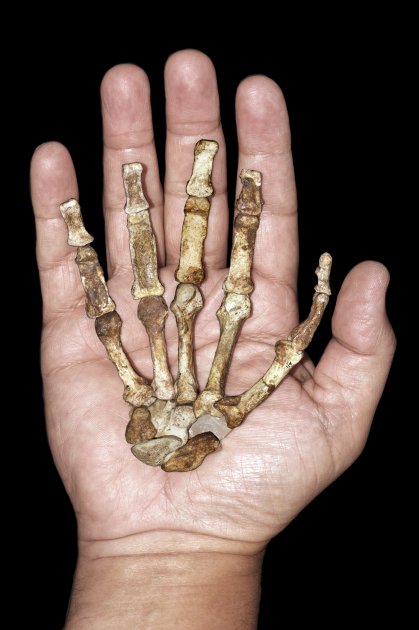
Human Evolution - New Fossil Evidence Further Establishes Our Place In Nature


This image released by the journal Science shows the right hand skeleton of the adult female Australopithecus sediba against a modern human hand. A detailed analysis of 2 million-year-old bones found
Photo By AP/Peter Schmid, courtesy of Lee Berger and the University of Witwatersrand
UPDATE: 
Closest Human Ancestor May Re-write Steps in Our Evolution, Yahoo News/Live Science, September 9, 2011
Earliest Signs of Advanced Tools Found, The New York Times, Science, August 31, 2011
Human Ancestor Older Than Previously Thought;  Finding Offers New Insights Into Human Evolution, Science Daily, June 20, 2011
New Fossils May Redraw Human Ancestry, The New York Times, Science, September 8, 2011

ORIGINAL POST
Recently discovered 2 million year old fossil specimens were presented at the April 18, 2011 meeting of the American Physical Anthropology Association and are still being analyzed.  The conjecture that they represent a transitional form between genus Australopithecus africanus and genus Homo habilis is being questioned by other scientists:  "Ian Tattersall of the American Museum of Natural History in New York City endorsed A. sediba as a distinct species, probably closely related to A. africanus. 'I wouldn’t classify it as the root of the Homo genus, though,' he commented."

Fresh Evidence Adds Weight to Human Ancestor's Identity
Possible New Human Ancestor Discovered

Australopithecus sediba fossils


April 22, 2011

Myths About Evolution And Secularism - An Outline

by Jim Lassiter

[A talk given at the monthly meeting of the Fayette Freethought Society, Peachtree City, Georgia, April 21, 2011.]

I would like to thank the Fayette Freethought Society (FFS), and in particular Julie Williams, for inviting me to give a talk on secularism and the major myths about evolution.  I would also like to welcome all of you here and thank you for coming.  I am grateful to FFS for providing a forum for the open expression of free thought.

Nature, culture, and science have interested me from an early age and contain themes that dominate my life and work.  These themes are in fact truths in my life and include the following:

  • Nature is powerful and worthy of respect.  We are of it, not above it.
  • Humans behave based on cultural knowledge and reasoning.  I am optimistic.
  • Science is a fitting and useful truth.

My earliest years were spent in Florida, NC, GA, Alaska.  Florida’s panhandle on the Gulf of Mexico, southern Georgia near the Okefenokee Swamp, and farm country North Carolina not far from the Great Dismal Swamp provided natural environments that could not be ignored.  Winters and summer fishing trips in Alaska’s wilderness in the late 1950s powerfully informed this eight-year old boy of his place within and subordinate to Nature.

In early adulthood I lived in northern California, Germany, Japan and went to graduate school in Oregon.  I served as a Peace Corps high school science teacher in the Kingdom of Swaziland, southern Africa for 3.5 years.  All these locations were rich environments that increased my appreciation for Nature, culture and science.

In the mid-late 1980s I directed Peace Corps programs in Tanzania and Ghana where the Volunteers taught math and science and introduced tilapia fish farming and other forms of technical assistance, and engaged in cultural exchanges.  Latter I interviewed thousands of African refugees who sought refuge from persecution via the US Refugee Resettlement program – as a result my appreciation for Nature, culture and science deepened.

Now retired from federal government service, I have begun the final phase of my life’s work – promoting a broader and deeper understanding of Nature, culture and science as bases for helping Humankind achieve a global morality and civilization.  I am doing this through my blog and though research on my wife’s ethnic group in eastern Uganda.  I mention this background to show that my passion for Nature, culture and science is subjective and humanistic as well as objective and practical.   Our continued ignorance of or disdain for Nature, other cultures and science is not an option.  The survival of our species and the biosphere depend on teaching the ignorant and confronting the arrogant and disdainful forces pitted against Nature and science.

  • The Top 10 Myths About Evolution by Cameron M. Smith and Charles Sullivan, 2007
  • The Top 10 Myths About of Evolution (And How We Know it Really Happened), The Skeptics Society, 2008
  • How to Debate a Creationist:  25 Answers To Classic Creationist Arguments and 10 Answers to Intelligent Design Creationist Arguments, Second Edition by Michael Shermer, The Skeptics Society, 2004

This evening I would like to present various myths about evolution topically, rather than try and cover them all.  Although they have proliferated and continue to do so unabated since the 1860s, they seem to cluster under about six topics.  These include:

  1. Evolution is just a theory, not proven and therefore no better than religious truth.
  2. “Survival of the fittest” is a natural no-holds-barred life and death struggle among organisms.
  3. Nature is purposeful and progressive.  That evolution happens by random chance makes it unbelievable.
  4. Creationism and ID trump science and evolution.
  5. Evolution is wrong to claim humans came from monkeys because the evidence for human evolution is fraudulent.
  6. Accepting evolution as truth is atheistic and therefore immoral.

April 17, 2011

Africa - Reducing Dependence On And Vulnerability To The Will And Whim Of Others

UPDATE:  The Aid Debate, A Presentation by George Ayittey, 2011 Oslo Freedom Forum, May 11, 2011 (move to 11:40 minute/second)

ORIGINAL POST
In the 1990s, while posted at one of the US Embassies in East Africa, Washington asked for our Embassy's mission goals and objectives.  At the Ambassador's open invitation I attended a lunch-hour "brown bag" discussion to informally discuss what our priorities for the coming year might be.  Upon entering the conference room there was an easel with newsprint displaying a list of priorities, in the following order:  Democracy, Good Governance (aka fighting government corruption), Civil Society, Economic Development, and Security.  It was a time in US foreign policy when democracy, governance and civil society issues dominated what the US wanted African countries to focus on.

As the discussion began I heard impressively articulated comments from around the table, particularly from seasoned mostly economics- and political science-educated foreign service offices (FSOs) calling for "leveraging" the host government to do this and that.  Each contributor placed emphasis on Washington's top mantras of the time - particularly, democracy, good governance.  Mind you, it was a time when many Africans who aspired to leadership were trying to figure out how to position themselves favorably in the eyes of the West as "democratic," yet ultimately rigging elections and taking their turn "eating" from international aid in all its forms - thus proving no better, and in some cases much worse, than those they had unseated.

Being an acting agency head yet not having the cuff links, quiche recipes and credentials of those seated next to me, I respectfully offered the following:

"Madame/Mister Ambassador, you may well have put those topics on the newsprint in random order (though I knew they were Main State's preferred order), I respectfully submit that we take a different approach to our "friends" and "partners" in the host country and its government.  Rather than view it as a wrestling match where we, the US, engages the host government in the standard referee's position then "leverages" them about the ring looking for opportunities to out-point, pin, or outright submit them, let's adopt a medical model.  Let's consider our friends and partners as having certain ailments - they are not well in certain ways and might, might, benefit from our help - and ask ouselves what the people, not necessarily the wealthy elite currently in power, want and need to prosper.

April 15, 2011

Language - Its Origins And Evolution

Modern language and speech can be traced back to the last common ancestor we shared with the Neandertals roughly half a million years ago, according to new research. (Credit: © procy_ab / Fotolia)


UPDATE:  On the Antiquity of Language: The Reinterpretation of Neandertal Linguistic Capacities and Its Consequences by Dan Dediu and Stephen C. Levinson, Frontiers in Psychology, July 6, 2013, Volume 4, Article 397, Pages 1-17.  Synopsis:  Neandertals Shared Speech and Language With Modern Humans, Study Says, Science Daily, Science News, July 9, 2013.

On the Antiquity of Language, Abstract:

“It is usually assumed that modern language is a recent phenomenon, coinciding with the emergence of modern humans themselves. Many assume as well that this is the result of a single, sudden mutation giving rise to the full 'modern package.' However, we argue here that recognizably modern language is likely an ancient feature of our genus predating at least the common ancestor of modern humans and Neandertals about half a million years ago. To this end, we adduce a broad range of evidence from linguistics, genetics, paleontology, and archaeology clearly suggesting that Neandertals shared with us something like modern speech and language. This reassessment of the antiquity of modern language, from the usually quoted 50,000–100,000 years to half a million years, has profound consequences for our understanding of our own evolution in general and especially for the sciences of speech and language. As such, it argues against a saltationist scenario for the evolution of language, and toward a gradual process of culture-gene co-evolution extending to the present day. Another consequence is that the present-day linguistic diversity might better reflect the properties of the design space for language and not just the vagaries of history, and could also contain traces of the languages spoken by other human forms such as the Neandertals.”

ORIGINAL POST
Human language evolved from vocal call and alarm communications systems characteristic of most vertebrates, and virtually all mammals.  For Homo sapiens the emergence of complex symbolic language is increasingly being thought to have occurred about 100,000 years ago.

Selective pressure for language began on our ancestors' at the time of their entrance into a new eco-niche, the grasslands of east and southern Africa.  Selective pressures for complex vocal communication and symbolic thought also brought about changes in the structure and capabilities of the speech organs of our ancestors, namely the pharynx and tongue, and changes in the structure and functioning of parts of the brain that integrated visual images, labelling, remembered experience and mutually agreed upon vocalizations and non-vocal communication.  Exactly when the changes began and were completed is not known.

The Australopithecines, a group ancestral to genus Homo (sp.), may or may not have spoken a proto-language.  Most experts think they did not.  They think the first representatives of genus Homo, which emerged from one line of Australopithecines (A. afarensis?) about 2.5mya, were likely the first human ancestors to use language.  I think human language emerged earlier and gradually over a long period of time, as an elaboration of the vocal and gestural communication system characteristic of other primates, mammals and our proto-human ancestors, rather than a relatively sudden, from nothing to fully-fledged, emergence among Homo sapiens 100,000 years ago. 

April 12, 2011

A "Lousy" Chapter In Evolutionary History - Examining Our Roots

Here's a post that will make you scratch your head in wonder.

Natural historians, paleontologists and paleoanthropolists will leave no rock unturned, no geoligical stratum unexcavated, or hairy or feathered spot uninvestigated in their efforts to get to the root of or gather and corroborate information on the evolution of Life on Earth.

"Hairy or feathered spots?!"  Yes.  The natural history of lice, those pesky creatures that live on birds and mammals, provides important information for understanding the evolutionary history of dinosaurs, birds and mammals, including Homo sapiens.

Photo: New York Times/The Natural History of London

Did you know human head, body and pubic lice are related to lice found on modern chimpanzees and gorillas?  Check out the following link.  Don't be surprised if you begin to itch while you are reading:  As Mammals Supplanted Dinosaurs, Lice Kept Pace by Nicholas Wade, The New York Times, April 6, 2011.

Scratch, scratch!  Don't worry, it's probably just dry skin.  Then again....

April 9, 2011

Our 13.7 Billion Year-Old Universe

Ample Time, Matter And Dynamism For Life To Emerge and Evolve Once, Maybe More Often

UPDATE:  A galaxy formed 13.5 billion years ago has been discovered:  NASA's Telescopes Help Discover a Surprisingly Young Galaxy

The giant cluster of elliptical galaxies in the center of this image contains so much dark matter mass that its gravity bends light. This means that for very distant galaxies in the background, the cluster¹s gravitational field acts as a sort of magnifying glass, bending and concentrating the distant objects' light. These gravitational lenses are one tool astronomers can use to extend the vision of telescopes beyond what they would normally be capable of observing.  This particular lens, called Abell 383, was used to find a galaxy so far away that we see it as it was less than a billion years after the Big Bang. This distant galaxy's light has been warped into two, very faint images that are hard to see in this view.  Image credit: NASA, ESA, CRAL, LAM, STScI

ORIGINAL POST
Galaxy NGC 1300, a small part of our Universe:

A Hubble Space Telescope (HST) image of NGC 1300.
Credit: HST/
NASA/ESA

For more space telescopic images of objects within our galaxy and beyond and further information on what is known about our Universe, see Our Observable Universe and NASA's article on The Age of the Universe. 

April 6, 2011

Secular Global Morality And Civilization - Getting There, One Intervention At A Time

UPDATE 2:  "The Evolution of Binghamton, One Block at a Time" by Mark Oppenheimer, The New York Times, Books, August 31, 2011, a review of the book The Neighborhood Project: Using Evolution to Improve My City, One Block at a Time by David Sloan Wilson (2011).  A micro, pluralistic approach to working for the emergence of a new global morality and civilization.  See also Can Darwinism Improve Binghamton? by Jerry A. Coyne, The New York Times, Sunday Book Review, September 11, 2011

UPDATE 1:  Reforming the United Nations:  The Future of US Policy, by Ambassador Susan E. Rice, April 7, 2011.  "The (United Nations Human Rights) Council must deal with human rights emergencies wherever they occur...."

Amb. Rice's statement affirms the new approach to UN intervention discussed below.  See the following link for more information on the council she refers to which was created in 2006:  UN Human Rights Council.
ORIGINAL POST
Encouraging news regarding efforts to achieve a global morality and civilization!

UN Intervention in Ivory Coast Marks Policy Shift

"Belief, Science, Survival" Revisited - Join The Discussion

UPDATE October 19, 2012
Anti-Science Beliefs Jeorpardize U.S. Democracy, by Shawn Lawrence Otto, Scientific American, October 17, 2012 

ORIGINAL POST
The following is my reply to a number of constructively critical comments made in response to my September 23, 2010 blog post Belief, Science, Survival by my good friend and published author Craig M. White.  To understand the background behind what follows, you are invited to look at this brief post and the comments that follow by Craig, another friend, Kevin Graham, and me.

I have known Craig for many years, having worked with him in Washington and in Africa in the US Refugee Resettlement Program.  I have the greatest respect for Craig’s scholarship, and his views regarding human affairs and the “bigger questions” of Life.  Rather than reply as a comment to a string of Craig’s posts, I am making a new post so that Craig’s, Kevin’s and my views might be shared more widely and thereby bring more of you into the discussion.  The issues Craig and I are discussing – the nature of “truth” and evidence, responding to the complexities of our Universe and Life, the need or lack of need for a creator God – are not wasteful mental wheel-spinning.  They are questions that are at the core of each of our very being.  We all think about them quite often, fleetingly or in incomplete snatches.  Yet rarely do we have, find or take time to give them serious consideration or sort out exactly what it is we believe in or accept as truth.  Reading the original post, its comments and the following is an opportunity to do so.

There are no right or wrong answers to the questions we raise.  There is, however, one future ahead of Humankind.  The course we take to that future will depend on what we accept as truth and what actions we take as individuals, nations and as a species based on that truth.  It is likely that the world’s powerful and wealthy will lead us.  But we, each of us, now and into the future, can influence where Humankind ends up.  Join us in trying to influence what direction we shall take.

~ ~ ~ ~ ~ ~ ~

Thank you, Craig, for your kind and incisive comments on my blog post Belief, Science, Survival.  I very much agree with you, comprehending and accepting scientific accounts of cosmological and evolutionary time and events is not easy.  Within the scientific truth regarding our Universe there are huge gaps in our knowledge, great possibility for error, and significant on-going scientific debate and revision.  One obviously must somehow address these and other shortcomings of science and secularism before committing to such a truth.  Rather than respond to each point in your comments, most of which I have already addressed or referred to in the writings of others elsewhere in my blog,1 let me address the major aspects of scientific knowledge you draw attention to and claim have serious shortcomings.  Shortcomings you believe make science no more convincing than the absolute truth of the Abrahamic religions, namely Christianity. 

April 4, 2011

Mercury No "Goldilocks" Planet: 800°F Days, -300°F Nights

Another step in the growth of scientific knowlodge....

There may be polar icecaps, frozen water in its craters and signs of the early stages of plate tectonics on Mercury....


                                                                                                NASA Photos 2011

In NASA's Lens, Mercury Comes Into Focus, by Kenneth Chang, The New York Times, March 31, 2011

Archive for "Being Human"