May 29, 2011

Secularism, Theism And The Emergence Of A Global Morality And Civilization

UPDATE:  See Postscript, below.

Currently there are approximately 6.9 billion people on earth.  A conservative estimate of 4.71 billion, approximately 67%, believe in supernatural beings and forces.  Here's a breakdown by religious belief:

Hinduism:  .95 billion
Judaism: .13 billion
Islam:  1.3 billion
Christianity:  1.9 billion
Animism:  .23 billion
Other Theisms:  .2 billion

The remaining 2.19 billion, or 33%, include Buddhists and secularists such as atheists, humanists and agnostics.

Belief in supernatural beings and forces most likely began after our ancestors had invented symbolic speech and language, approximately 100,000BP.  Our ancestors may have begun to think symbolically before this in that there is compelling evidence that other animals - the great apes, dogs, dolphins, and others - also think symbolically though to a lesser degree and effect than humans.

With the advent of symbolic speech and language came the attendant ability to think of and comment in detail on events in the past and present, and possible events in the future.  The ability to consider and discuss these events and their possible causes and effects gave rise to numerous explanations for the origin and workings of the forces of Nature and the objects of the day and night sky.  Among these explanations were the invention of supernatural forces and human-like and nonhuman-like gods.

May 21, 2011

Our Future In Nature - Human Dignity, Democracy, Earth Stewardship


You are a child of the universe,
No less than the trees and the stars;
You have a right to be here.
And whether or not it is clear to you,
No doubt the universe is unfolding as it should.

- From Desiderata by Max Ehrmann, 1927

It is Sunday, May 22, 2011 in East Africa, the Cradle of Humankind.  If you are reading this, you were not yesterday raptured into heaven as was predicted by evangelical Christian Harold Camping.  Either you were not worthy of God's heaven or Camping's prediction was wrong.  In all seriousness, there is a viable future for Humankind, here, on Earth, with each other.  Looking toward and building our future soberly, scientifically, humanely will suffice.  I believe it is our only real chance to survive and prosper.

As I have written elsewhere on this blog, I am optimistic that Humankind will eventually bring into existence the global morally and civilization that we have begun and are building.  This new Earth ethic and unified approach to achieving and maintaining human dignity, peacefully resolving conflict, and sustaining the biosphere through our stewardship are the most important and imperative tasks of our present.  To fail will mean the loss of our humanity, community of cultures, and home in the Universe.

May 18, 2011

The End Of The World ~ Many Believe It Will Begin On May 21, 2011 With The Rapture

Yes, the last day will be May 21, 2011, according to Harold Camping, an evangelical Christian in California. 

If you are around on May 22, it means you were not one of the chosen ones who were raptured up to heaven by Jesus.  You will still have five more months to mill about and try converting to Christianity before the Earth is destroyed on October 21.  But I'm told it will be too late for conversion after May 21.  It seems the Christian God allows conversions from prison cells and deathbeds, but for some reason not at the end of the world.  It appears that you are acceptable into Heaven if you accept God based on faith before the rapture, but not if you have merely witnessed and are convinced of His omnipotence as evidenced by His son's return and the rapture.  Doesn't seem like a kind, loving, perfect God - more like a selfish, vengeful, stingy one to me.  But who am I to judge....

May 16, 2011

Religion And Science Compete To Influence Humankind - Issues, Proofs, Venues, and Implications

The Myth of Separate Magisteria, Susan Jacoby, Big Questions Online, October 7, 2010
How Did God Get Started?
Haiti and the Hypocrisy of Christian Theology
A Synthesis of Science and Religion - Is One Needed?  Is One Possible?
Is scientific knowledge as good or better than religion as a basis for values and morals?
Author Offers Evolutionary Explanation of Religion
Where The Substance Really Isn't by Tim Callahan, a review of Where The Conflict Really Lies: Science Religion and Naturalism by Alvin Plantinga, eSkeptic, November 2, 2011

Where and how science and religion compete and are therefore in conflict:
  • In terms of issues:  Truth, Morality
  • In terms of proof and evidence:  Methods, Standards
  • In terms of locale/context:  The Individual, Education, Societal Governance, Global Cooperation
  • In terms of implications for the biosphere:  Plant and Animal (including Humankind) Survival and Prosperity
It is inaccurate to say that science has been or is actively, directly competing with religion in terms of gaining a greater influence over Humankind.  Science did not arise as a means of, or for the sake of, challenging religion.  It arose as a human generated form of knowledge motivated by curiosity and based on findings derived from observation and experiment.  That it came into conflict with religion resulted from a growing amount of demonstrable information that conflicted with religious accounts of the same phenomena, and the reaction of religion's leaders to the information and explanations that science arrived at concerning the matter and processes found on Earth, in Life, and in the Universe.  Religious leaders did not want to change their views based on these new ideas.  Today, many still don't want to.  But many others have changed their amended their truth by accepting the findings of science, but retained a belief in God as the creative, motive force behind it all.  Others, Biblical literalists and fundamentalist Christians, have rejected those truths of science that conflict with their revealed truth, particularly about the origins and evolution of Earth and its life, including humans.

May 6, 2011

Human Evolution - Education Resources and Evidence

A great resource on human evolution (with links) put together by Caitlin Schrein, anthropology doctoral candidate at Arizona State University:

Human Evolution Education Resources, paleophile, May 4, 2011

Here's another great site on human evolution by Jim Foley where you can see photos of the fossils and more:

Fossil Hominids:  The Evidence for Human Evolution

May 5, 2011

National Day of Reason - May 5, 2011

Congressional Floor Statement:  Supporting the National Day of Reason by Pete Stark, House of Representatives

For the Congressional Record
May 5, 2011

Statement of Congressman Pete Stark Recognizing the National Day of Reason

MR. STARK: Mr. Speaker, I rise today to recognize Thursday, May 5, 2011 as the 2011 National Day of Reason.

The National Day of Reason, observed by millions of people in this country and around the world since 2003, celebrates the application of reason and the positive impacts it has had on humanity.  Reason and rational discourse have the power to improve living conditions around the world and cultivate intelligent, moral, and ethical interactions among people.

Reason and rational thinking have made our country great. The Constitution of the United States of America is based upon the philosophies developed during the historical Age of Reason and the idea that citizens engaging in rational discourse and decision-making can govern themselves.  The Constitution also contains a strong separation of church and state, making it clear that government should continue to be built on reason.

May 3, 2011

Why Americans Dislike Atheists - Two Views, One Subtle The Other Bare-Knuckle

I contend that we are both atheists. I just believe in one fewer god than you do. When you understand why you dismiss all the other possible gods, you will understand why I dismiss yours. - Stephen F. Roberts

UPDATE:
Atheism in America, FT Magazine, February 3, 2011
A New Fox Poll on Evolution, National Center for Science Education, September 7, 2011
Why U.S. Is Not a Christian Nation by Kenneth C. Davis, CNN Opinion, July 4, 2011
A.C. Grayling:  "How can you be a militant atheist?  It's like sleeping furiously," The Guardian, April 3, 2011

ORIGINAL POST
Atheists fed up?  Believe it! by Gregory Paul, The Washington Post, June 16, 2011

Why do Americans still dislike atheists? by Gregory Paul and Phil Zuckerman, The Washington Post, April 29, 2011

"Rarely denounced by the mainstream, this stunning anti-atheist discrimination is egged on by Christian conservatives who stridently — and uncivilly — declare that the lack of godly faith is detrimental to society, rendering nonbelievers intrinsically suspect and second-class citizens."
...
"As with other national minority groups, atheism is enjoying rapid growth. Despite the bigotry, the number of American nontheists has tripled as a proportion of the general population since the 1960s. Younger generations’ tolerance for the endless disputes of religion is waning fast. Surveys designed to overcome the understandable reluctance to admit atheism have found that as many as 60 million Americans — a fifth of the population — are not believers. Our nonreligious compatriots should be accorded the same respect as other minorities."
~ ~ ~ ~
A more in-depth, less polite (to put it mildly) treatment of religion, what atheism is today, and why so many Americans have misconceptions about it can be found in A Voice of Reason in an Unreasonable World:  The Rise of Atheism on Planet Earth by Al Stefanelli (2011).  Stefanelli is a journalist and a former Baptist minister, preacher and evangelist.  He became an atheist and founded the United Atheist Front in 2005.

May 2, 2011

Time Does Not Objectively Exist - Scientists Say It Is Only Our Numerical Ordering Of Change

Photo credit:  Wikimedia Commons

UPDATE
A Science Without Time by Gene Tracy, Aeon, April 25, 2016

Did Time Begin With A Bang? by Raymond Tallis, Tallis in Wonderland in Philosophy Now, September/October 2012

ORIGINAL POST
Scientists Suggest Spacetime Has No Time Dimension, PHYSORG.COM, April 25, 2011

The implications of these ideas are amazing!  I'm not sure I understand the contents of the link, but here is what I think the researchers are talking about:

Think of our expanding Universe - galaxies are becoming further and further apart from each other.  Scientists can measure the distance one galaxy moves relative to another.  We typically give one location a number, say, 1, and observe that the galaxy is moving away from location 1 relative to another galaxy.  We assign the number 2 to the location of the galaxy after it has moved from location 1.

April 28, 2011

Our Species Is Getting Taller, Heavier And Living Longer - But Many In Poor Countries Are Not

I hope none of you reading this and the two articles cited below will lapse into the long ago debunked misconception of evolutionary theory known as Social Darwinism and wrongly think:  "Well this news is not surprising, it's only natural.  It's survival of the fittest."  Please read on....

Improvements in food production and public health over the past 300 years have made us taller, heavier and helped us to live longer.  These changes in the human body have happened more rapidly than in the previous thousands of years of our evolutionary history.  From the link article:

"To take just a few examples, the average adult man in 1850 in America stood about 5 feet 7 inches and weighed about 146 pounds; someone born then was expected to live until about 45. In the 1980s the typical man in his early 30s was about 5 feet 10 inches tall, weighed about 174 pounds and was likely to pass his 75th birthday.

April 27, 2011

Free Will - Of course we have it! Don't we?

Art by Mark David Dietz, used with permission

Originally published in 2004 in Skeptic magazine, the following article discusses a matter that has been of great importance from ancient times to the present, and resides at the heart of our scientific understanding of Humankind - Free Will:  Zeno's Paradox, and the Problem of Free Will by Phil Molé, reprinted in eSkeptic on April 27, 2011.

Sociobiologists, for example, seeking the biological foundations of human behavior, including thought, argue that there is no such thing as Free Will.  That humans behave within a determined range of behavior because they are material objects made up of elements whose physical and "behavioral" characteristics are known to allow only certain behaviors and not others.  Therefore, they argue, Humans have no Free Will.

There are other behavioral scientists who argue to the contrary that the sociobiologists' limited definition of Free Will does not mean there is no Free Will at all.  They say, in essence, Free Will is is not an all or nothing condition.  To have Free Will does not mean we are free to do anything we want.  It is a condition of existence where we have the ability to choose among behavioral options we can carry out within the physical laws of Nature.  The Human ability to exercise Free Will in terms of "thought" options is unlimited much as is the Human imagination.  Thus our behavior is limited by the laws of the material universe but our thinking is an emergent property with unlimited options.

April 25, 2011

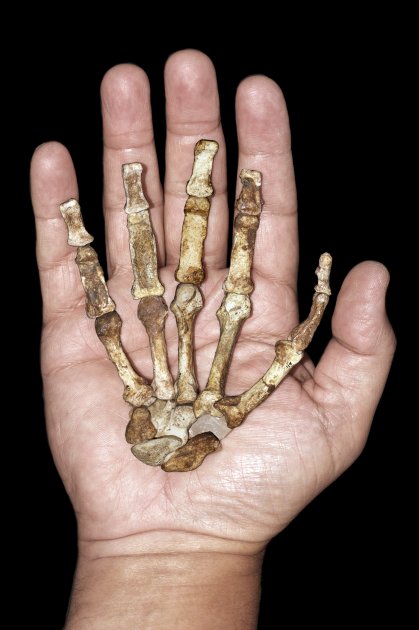
Human Evolution - New Fossil Evidence Further Establishes Our Place In Nature


This image released by the journal Science shows the right hand skeleton of the adult female Australopithecus sediba against a modern human hand. A detailed analysis of 2 million-year-old bones found
Photo By AP/Peter Schmid, courtesy of Lee Berger and the University of Witwatersrand
UPDATE: 
Closest Human Ancestor May Re-write Steps in Our Evolution, Yahoo News/Live Science, September 9, 2011
Earliest Signs of Advanced Tools Found, The New York Times, Science, August 31, 2011
Human Ancestor Older Than Previously Thought;  Finding Offers New Insights Into Human Evolution, Science Daily, June 20, 2011
New Fossils May Redraw Human Ancestry, The New York Times, Science, September 8, 2011

ORIGINAL POST
Recently discovered 2 million year old fossil specimens were presented at the April 18, 2011 meeting of the American Physical Anthropology Association and are still being analyzed.  The conjecture that they represent a transitional form between genus Australopithecus africanus and genus Homo habilis is being questioned by other scientists:  "Ian Tattersall of the American Museum of Natural History in New York City endorsed A. sediba as a distinct species, probably closely related to A. africanus. 'I wouldn’t classify it as the root of the Homo genus, though,' he commented."

Fresh Evidence Adds Weight to Human Ancestor's Identity
Possible New Human Ancestor Discovered

Australopithecus sediba fossils


April 22, 2011

Myths About Evolution And Secularism - An Outline

by Jim Lassiter

[A talk given at the monthly meeting of the Fayette Freethought Society, Peachtree City, Georgia, April 21, 2011.]

I would like to thank the Fayette Freethought Society (FFS), and in particular Julie Williams, for inviting me to give a talk on secularism and the major myths about evolution.  I would also like to welcome all of you here and thank you for coming.  I am grateful to FFS for providing a forum for the open expression of free thought.

Nature, culture, and science have interested me from an early age and contain themes that dominate my life and work.  These themes are in fact truths in my life and include the following:

  • Nature is powerful and worthy of respect.  We are of it, not above it.
  • Humans behave based on cultural knowledge and reasoning.  I am optimistic.
  • Science is a fitting and useful truth.

My earliest years were spent in Florida, NC, GA, Alaska.  Florida’s panhandle on the Gulf of Mexico, southern Georgia near the Okefenokee Swamp, and farm country North Carolina not far from the Great Dismal Swamp provided natural environments that could not be ignored.  Winters and summer fishing trips in Alaska’s wilderness in the late 1950s powerfully informed this eight-year old boy of his place within and subordinate to Nature.

In early adulthood I lived in northern California, Germany, Japan and went to graduate school in Oregon.  I served as a Peace Corps high school science teacher in the Kingdom of Swaziland, southern Africa for 3.5 years.  All these locations were rich environments that increased my appreciation for Nature, culture and science.

In the mid-late 1980s I directed Peace Corps programs in Tanzania and Ghana where the Volunteers taught math and science and introduced tilapia fish farming and other forms of technical assistance, and engaged in cultural exchanges.  Latter I interviewed thousands of African refugees who sought refuge from persecution via the US Refugee Resettlement program – as a result my appreciation for Nature, culture and science deepened.

Now retired from federal government service, I have begun the final phase of my life’s work – promoting a broader and deeper understanding of Nature, culture and science as bases for helping Humankind achieve a global morality and civilization.  I am doing this through my blog and though research on my wife’s ethnic group in eastern Uganda.  I mention this background to show that my passion for Nature, culture and science is subjective and humanistic as well as objective and practical.   Our continued ignorance of or disdain for Nature, other cultures and science is not an option.  The survival of our species and the biosphere depend on teaching the ignorant and confronting the arrogant and disdainful forces pitted against Nature and science.

  • The Top 10 Myths About Evolution by Cameron M. Smith and Charles Sullivan, 2007
  • The Top 10 Myths About of Evolution (And How We Know it Really Happened), The Skeptics Society, 2008
  • How to Debate a Creationist:  25 Answers To Classic Creationist Arguments and 10 Answers to Intelligent Design Creationist Arguments, Second Edition by Michael Shermer, The Skeptics Society, 2004

This evening I would like to present various myths about evolution topically, rather than try and cover them all.  Although they have proliferated and continue to do so unabated since the 1860s, they seem to cluster under about six topics.  These include:

  1. Evolution is just a theory, not proven and therefore no better than religious truth.
  2. “Survival of the fittest” is a natural no-holds-barred life and death struggle among organisms.
  3. Nature is purposeful and progressive.  That evolution happens by random chance makes it unbelievable.
  4. Creationism and ID trump science and evolution.
  5. Evolution is wrong to claim humans came from monkeys because the evidence for human evolution is fraudulent.
  6. Accepting evolution as truth is atheistic and therefore immoral.

April 17, 2011

Africa - Reducing Dependence On And Vulnerability To The Will And Whim Of Others

UPDATE:  The Aid Debate, A Presentation by George Ayittey, 2011 Oslo Freedom Forum, May 11, 2011 (move to 11:40 minute/second)

ORIGINAL POST
In the 1990s, while posted at one of the US Embassies in East Africa, Washington asked for our Embassy's mission goals and objectives.  At the Ambassador's open invitation I attended a lunch-hour "brown bag" discussion to informally discuss what our priorities for the coming year might be.  Upon entering the conference room there was an easel with newsprint displaying a list of priorities, in the following order:  Democracy, Good Governance (aka fighting government corruption), Civil Society, Economic Development, and Security.  It was a time in US foreign policy when democracy, governance and civil society issues dominated what the US wanted African countries to focus on.

As the discussion began I heard impressively articulated comments from around the table, particularly from seasoned mostly economics- and political science-educated foreign service offices (FSOs) calling for "leveraging" the host government to do this and that.  Each contributor placed emphasis on Washington's top mantras of the time - particularly, democracy, good governance.  Mind you, it was a time when many Africans who aspired to leadership were trying to figure out how to position themselves favorably in the eyes of the West as "democratic," yet ultimately rigging elections and taking their turn "eating" from international aid in all its forms - thus proving no better, and in some cases much worse, than those they had unseated.

Being an acting agency head yet not having the cuff links, quiche recipes and credentials of those seated next to me, I respectfully offered the following:

"Madame/Mister Ambassador, you may well have put those topics on the newsprint in random order (though I knew they were Main State's preferred order), I respectfully submit that we take a different approach to our "friends" and "partners" in the host country and its government.  Rather than view it as a wrestling match where we, the US, engages the host government in the standard referee's position then "leverages" them about the ring looking for opportunities to out-point, pin, or outright submit them, let's adopt a medical model.  Let's consider our friends and partners as having certain ailments - they are not well in certain ways and might, might, benefit from our help - and ask ouselves what the people, not necessarily the wealthy elite currently in power, want and need to prosper.

April 15, 2011

Language - Its Origins And Evolution

Modern language and speech can be traced back to the last common ancestor we shared with the Neandertals roughly half a million years ago, according to new research. (Credit: © procy_ab / Fotolia)


UPDATE:  On the Antiquity of Language: The Reinterpretation of Neandertal Linguistic Capacities and Its Consequences by Dan Dediu and Stephen C. Levinson, Frontiers in Psychology, July 6, 2013, Volume 4, Article 397, Pages 1-17.  Synopsis:  Neandertals Shared Speech and Language With Modern Humans, Study Says, Science Daily, Science News, July 9, 2013.

On the Antiquity of Language, Abstract:

“It is usually assumed that modern language is a recent phenomenon, coinciding with the emergence of modern humans themselves. Many assume as well that this is the result of a single, sudden mutation giving rise to the full 'modern package.' However, we argue here that recognizably modern language is likely an ancient feature of our genus predating at least the common ancestor of modern humans and Neandertals about half a million years ago. To this end, we adduce a broad range of evidence from linguistics, genetics, paleontology, and archaeology clearly suggesting that Neandertals shared with us something like modern speech and language. This reassessment of the antiquity of modern language, from the usually quoted 50,000–100,000 years to half a million years, has profound consequences for our understanding of our own evolution in general and especially for the sciences of speech and language. As such, it argues against a saltationist scenario for the evolution of language, and toward a gradual process of culture-gene co-evolution extending to the present day. Another consequence is that the present-day linguistic diversity might better reflect the properties of the design space for language and not just the vagaries of history, and could also contain traces of the languages spoken by other human forms such as the Neandertals.”

ORIGINAL POST
Human language evolved from vocal call and alarm communications systems characteristic of most vertebrates, and virtually all mammals.  For Homo sapiens the emergence of complex symbolic language is increasingly being thought to have occurred about 100,000 years ago.

Selective pressure for language began on our ancestors' at the time of their entrance into a new eco-niche, the grasslands of east and southern Africa.  Selective pressures for complex vocal communication and symbolic thought also brought about changes in the structure and capabilities of the speech organs of our ancestors, namely the pharynx and tongue, and changes in the structure and functioning of parts of the brain that integrated visual images, labelling, remembered experience and mutually agreed upon vocalizations and non-vocal communication.  Exactly when the changes began and were completed is not known.

The Australopithecines, a group ancestral to genus Homo (sp.), may or may not have spoken a proto-language.  Most experts think they did not.  They think the first representatives of genus Homo, which emerged from one line of Australopithecines (A. afarensis?) about 2.5mya, were likely the first human ancestors to use language.  I think human language emerged earlier and gradually over a long period of time, as an elaboration of the vocal and gestural communication system characteristic of other primates, mammals and our proto-human ancestors, rather than a relatively sudden, from nothing to fully-fledged, emergence among Homo sapiens 100,000 years ago. 

April 12, 2011

A "Lousy" Chapter In Evolutionary History - Examining Our Roots

Here's a post that will make you scratch your head in wonder.

Natural historians, paleontologists and paleoanthropolists will leave no rock unturned, no geoligical stratum unexcavated, or hairy or feathered spot uninvestigated in their efforts to get to the root of or gather and corroborate information on the evolution of Life on Earth.

"Hairy or feathered spots?!"  Yes.  The natural history of lice, those pesky creatures that live on birds and mammals, provides important information for understanding the evolutionary history of dinosaurs, birds and mammals, including Homo sapiens.

Photo: New York Times/The Natural History of London

Did you know human head, body and pubic lice are related to lice found on modern chimpanzees and gorillas?  Check out the following link.  Don't be surprised if you begin to itch while you are reading:  As Mammals Supplanted Dinosaurs, Lice Kept Pace by Nicholas Wade, The New York Times, April 6, 2011.

Scratch, scratch!  Don't worry, it's probably just dry skin.  Then again....

April 9, 2011

Our 13.7 Billion Year-Old Universe

Ample Time, Matter And Dynamism For Life To Emerge and Evolve Once, Maybe More Often

UPDATE:  A galaxy formed 13.5 billion years ago has been discovered:  NASA's Telescopes Help Discover a Surprisingly Young Galaxy

The giant cluster of elliptical galaxies in the center of this image contains so much dark matter mass that its gravity bends light. This means that for very distant galaxies in the background, the cluster¹s gravitational field acts as a sort of magnifying glass, bending and concentrating the distant objects' light. These gravitational lenses are one tool astronomers can use to extend the vision of telescopes beyond what they would normally be capable of observing.  This particular lens, called Abell 383, was used to find a galaxy so far away that we see it as it was less than a billion years after the Big Bang. This distant galaxy's light has been warped into two, very faint images that are hard to see in this view.  Image credit: NASA, ESA, CRAL, LAM, STScI

ORIGINAL POST
Galaxy NGC 1300, a small part of our Universe:

A Hubble Space Telescope (HST) image of NGC 1300.
Credit: HST/
NASA/ESA

For more space telescopic images of objects within our galaxy and beyond and further information on what is known about our Universe, see Our Observable Universe and NASA's article on The Age of the Universe. 

April 6, 2011

Secular Global Morality And Civilization - Getting There, One Intervention At A Time

UPDATE 2:  "The Evolution of Binghamton, One Block at a Time" by Mark Oppenheimer, The New York Times, Books, August 31, 2011, a review of the book The Neighborhood Project: Using Evolution to Improve My City, One Block at a Time by David Sloan Wilson (2011).  A micro, pluralistic approach to working for the emergence of a new global morality and civilization.  See also Can Darwinism Improve Binghamton? by Jerry A. Coyne, The New York Times, Sunday Book Review, September 11, 2011

UPDATE 1:  Reforming the United Nations:  The Future of US Policy, by Ambassador Susan E. Rice, April 7, 2011.  "The (United Nations Human Rights) Council must deal with human rights emergencies wherever they occur...."

Amb. Rice's statement affirms the new approach to UN intervention discussed below.  See the following link for more information on the council she refers to which was created in 2006:  UN Human Rights Council.
ORIGINAL POST
Encouraging news regarding efforts to achieve a global morality and civilization!

UN Intervention in Ivory Coast Marks Policy Shift

"Belief, Science, Survival" Revisited - Join The Discussion

UPDATE October 19, 2012
Anti-Science Beliefs Jeorpardize U.S. Democracy, by Shawn Lawrence Otto, Scientific American, October 17, 2012 

ORIGINAL POST
The following is my reply to a number of constructively critical comments made in response to my September 23, 2010 blog post Belief, Science, Survival by my good friend and published author Craig M. White.  To understand the background behind what follows, you are invited to look at this brief post and the comments that follow by Craig, another friend, Kevin Graham, and me.

I have known Craig for many years, having worked with him in Washington and in Africa in the US Refugee Resettlement Program.  I have the greatest respect for Craig’s scholarship, and his views regarding human affairs and the “bigger questions” of Life.  Rather than reply as a comment to a string of Craig’s posts, I am making a new post so that Craig’s, Kevin’s and my views might be shared more widely and thereby bring more of you into the discussion.  The issues Craig and I are discussing – the nature of “truth” and evidence, responding to the complexities of our Universe and Life, the need or lack of need for a creator God – are not wasteful mental wheel-spinning.  They are questions that are at the core of each of our very being.  We all think about them quite often, fleetingly or in incomplete snatches.  Yet rarely do we have, find or take time to give them serious consideration or sort out exactly what it is we believe in or accept as truth.  Reading the original post, its comments and the following is an opportunity to do so.

There are no right or wrong answers to the questions we raise.  There is, however, one future ahead of Humankind.  The course we take to that future will depend on what we accept as truth and what actions we take as individuals, nations and as a species based on that truth.  It is likely that the world’s powerful and wealthy will lead us.  But we, each of us, now and into the future, can influence where Humankind ends up.  Join us in trying to influence what direction we shall take.

~ ~ ~ ~ ~ ~ ~

Thank you, Craig, for your kind and incisive comments on my blog post Belief, Science, Survival.  I very much agree with you, comprehending and accepting scientific accounts of cosmological and evolutionary time and events is not easy.  Within the scientific truth regarding our Universe there are huge gaps in our knowledge, great possibility for error, and significant on-going scientific debate and revision.  One obviously must somehow address these and other shortcomings of science and secularism before committing to such a truth.  Rather than respond to each point in your comments, most of which I have already addressed or referred to in the writings of others elsewhere in my blog,1 let me address the major aspects of scientific knowledge you draw attention to and claim have serious shortcomings.  Shortcomings you believe make science no more convincing than the absolute truth of the Abrahamic religions, namely Christianity. 

April 4, 2011

Mercury No "Goldilocks" Planet: 800°F Days, -300°F Nights

Another step in the growth of scientific knowlodge....

There may be polar icecaps, frozen water in its craters and signs of the early stages of plate tectonics on Mercury....


                                                                                                NASA Photos 2011

In NASA's Lens, Mercury Comes Into Focus, by Kenneth Chang, The New York Times, March 31, 2011

March 30, 2011

Quacks and Quakes - Fox News Earthquake "Expert" Exposed as Crank

UPDATE:

USGS Hourly Global Earthquake Tracker:  Click here

ORIGNAL POST:

                                                                                                As of March 30, 2011

Quacks and Quakes by Donald Prothero, Skeptic, March 30, 2011.  Also see Prothero's Quakes and Fakes where he discusses the geophysical and gelogical details of the March 11 earthquake in Japan and the misinformation and myths about it, including that of the "end-of-the-world" doomsayers.

In "Quacks and Quakes" author and widely respected geologist and palaeontologist Donald R. Prothero exposes one of Fox News' "experts," Jim Berkland, and Berkland's pseudo-science for predicting earthquakes.  Berkland called for the "Big One" in California between March 19-26 during the "Supermoon".  Didn't happen.  Berkland hasn't been back on Fox.

Prothero's latest book, Catastrophes!:  Earthquakes, Tsunamis, Tornadoes, and other Earth-Shattering Disasters, published earlier this month, presents the facts and science of these natural disasters.

With all the misinformation and pseudo-science being presented as fact regarding the March 11 disaster in Japan, it might be a good time to remind ourselves of why people seem so prone to believe such unreasonable claims.  Michael Shermer presents a pretty good take on the reasons in his book Why People Believe Weird Things:  Pseudoscience, Superstition and Other Confusions of our Time (2002).

NOTE:  I have referred to the work of Prothero in earlier posts for evidence supporting evolutionary theory:  Evolution:  What the Fossils Say and Why It Matters, illustrated by Carl Buell (2007).

From Skeptic, March 30, 2011:  DR. DONALD R. PROTHERO is Professor of Geology at Occidental College in Los Angeles, and Lecturer in Geobiology at the California Institute of Technology in Pasadena. He earned M.A., M.Phil., and Ph.D. degrees in geological sciences from Columbia University in 1982, and a B.A. in geology and biology (highest honors, Phi Beta Kappa) from the University of California, Riverside. He is currently the author, co-author, editor, or co-editor of 25 books and over 250 scientific papers, including five leading geology textbooks and three trade books as well as edited symposium volumes and other technical works. He is on the editorial board of Skeptic magazine, and in the past has served as an associate or technical editor for Geology, Paleobiology and Journal of Paleontology. He is a Fellow of the Geological Society of America, the Paleontological Society, and the Linnaean Society of London, and has also received fellowships from the Guggenheim Foundation and the National Science Foundation. He has served as the Vice President of the Pacific Section of SEPM (Society of Sedimentary Geology), and five years as the Program Chair for the Society of Vertebrate Paleontology. In 1991, he received the Schuchert Award of the Paleontological Society for the outstanding paleontologist under the age of 40. He has also been featured on several television documentaries, including episodes of Paleoworld (BBC), Prehistoric Monsters Revealed (History Channel), Entelodon and Hyaenodon (National Geographic Channel) and Walking with Prehistoric Beasts (BBC).

March 28, 2011

First Humans In The Americas 15,500BP - New Evidence


Some of the artifacts from the 15,500-year-old horizon - Michael R. Waters

~~~~~~~~~~~~~~~~~~~~~~~~~~~~~~~~~~~~~~~~~~~~~~~~~~~~~~~~~~~~~~~~~~~~~~~~~~~~~~~~~~~~~~~~~~~~~

Above map and following excerpt from The Oldest Americans - An Introduction by George Weber:

The (above) routes into America were available to the intrepid and hardy Pleistocene and early Holocene traveler. The routes were undoubtedly used (although we cannot be sure which ones and by whom) and that from as early as 30,000 years ago. The people who set up camp at Monte Verde in Chile, for example, had to enter America by one of the routes or a combination of them.

(a) Bering Straight route (blue)
The Bering Strait before 10,000 years ago was an icy and stormy waterway and something for only the most fearless boat crew to attempt. Every so often, as the climate became colder and sea levels fell, the Strait would turn into dry land and could be crossed on foot by people with a well-established tradition of arctic survival.

March 22, 2011

Libya Intervention: Are African Leaders' Objections Justified, Credible?

UPDATE 2 Jacob Zuma criticises military action in Libya, BBC, July 18, 2011  Though most of the article deals with UK PM David Cameron's visit to RSA and UK-RSA trade relations, the first few paragraphs addresses Zuma's position on the situation in Libya.  Specifically, RSA President Jacob Zuma is calling for a negotiated settlement of the crisis in Libya, including the future of Gadaffi.  I have little doubt that Gaddafi is only buying time to see if there is any way at all he can hang on to power, but his expressed interest in giving negotiations a chance should be honored despite the fact he refused to give Libyan opposition a chance to negotiate.


I disagree with Zuma's belief that the NATO bombings are not helping the political situation in Libya.  Surely he does not believe that stopping the bombing would encourage Gadaffi to take negotiations more seriously.  The current course is the best - keep providing military support to the revolutionaries while keeping the door open to and allowing negotiations to commence simultaneously.


UPDATE  Rwanda Backs US Strikes on Libya  Rwanda's president Paul Kagame supports coalition raids on Libya.  Cites the international community's failure to intervene to prevent the genocide that took place in his country in 1994.

ORIGINAL POST:

Libya: Museveni, Mugabe and Zuma condemn air strikes
Museveni blasts West over Libya attack

Yoweri Museveni of Uganda and Robert Mugabe of Zimbabwe object to a multi-national force protecting civilians in Libya.  Libya's leader Colonel Muammar Gaddafi threatens to go door to door and kill those who have participated in a call for government reform and democracy.  Museveni, Mugabe and other African leaders' objections pertain to what they see as a lack of fairness, disrespect for sovereignty and the malevolent ulterior motives of the intervening coalition.

Are their objections justified?  What moral high ground do they occupy, if any, from which to speak out about unfairness, disrespect and ulterior motivations?

Egypt's Muslim Brotherhood - Honest Player Or Playing At Honesty To Buy Time? A Comment On "American Gullibility"

"Have more than thou showest, speak less than thou knowest." - The Fool to Lear, King Lear, Act I, Scene iv

There is something peculiar about Western, and in particular American, approaches to international relations.  Our leaders have a tendency to trust first, then only change their mind if and only if they must.  This also a deeply ingrained belief among America's leaders that if a promise is in writing, such as a treaty or cease-fire or a non-aggression pact, and it has been signed, then it is binding and assumed that the signatories will comply with its terms.  Why is this?

March 20, 2011

Global Population 10.5 Billion By 2050 - Will Our Species' Primary Evolutionary Strategy, Cultural Adaptation, Succeed Against This Challenge?

UPDATE:  Census Update: What the World Will Look Like in 2050, Time Magazine, June 30, 2011
Now We Are Seven Billion, The Economist, October 22, 2011

ORIGINAL POST:
The Answer:  We have no option but rely on it.  But what choices will it force us to make and who will make them?  No-one knows if our efforts will succeed.  For we humans, as individuals and as a species, live our lives forward into uncertainty based on what are most often good but always imperfect calculated risks.  Background:  Cultural Evolution, Phase II - Establishing A Unified Worldview  See also:  Earth's Senior Population Is Increasing - So What?

Clearly, the major choices and actions that must be taken are in the following areas:

An emerging global civilization and morality
The meaning and value we continue to place on human life
Addressing the unequal spread of Earth's wealth, power and privilege
Addressing global poverty
Protecting and preserving the biosphere

UPDATE - Population 7 Billion by End of 2011  Excerpts from the Update Link:

"'The exertions that men find it necessary to make, in order to support themselves or families, frequently awaken faculties that might otherwise have lain for ever dormant, and it has been commonly remarked that new and extraordinary situations generally create minds adequate to grapple with the difficulties in which they are involved.'" - Thomas Malthus

"... the problem that needs solving is poverty and lack of infrastructure, not overpopulation."  ...  "The central challenge for the future of people and the planet is how to raise more of us out of poverty—the slum dwellers in Delhi, the subsistence farmers in Rwanda—while reducing the impact each of us has on the planet."

March 19, 2011

Swaziland Dissent - What Would King Sobhuza II Do?

UPDATE 
Swaziland: Government Coffers Are Running Dry, UN-IRIN Report, May 16, 2011
A King At Bay:  Africa's Last Absolute Monarchy May Be Falling Apart, The Economist, July 30, 2011

ORIGINAL POST
I lived and worked in the Kingdom of Swaziland, Southern Africa for three years in the early 1980s.  King Sobhuza II, who became Ngwenyama and ascended to the Swazi throne in 1921, was still king in 1980 when I arrived to teach science in a rural government high school.  This was a wonderful experience that greatly changed my life and for which I remain sincerely grateful.

King Sobhuza II (1899-1982)

I attended Sobhuza II's Diamond Jubilee in late 1981 at Somhlolo Stadium and joined all Swazis in mourning following his death on August 21, 1982.  Sobhuza II was a charismatic, beloved leader of his people and led them most ably through most of the 20th Century - the World Depression of the 1930s, World War II, and finally to independence from Britain in 1968.

His greatest strength was his personal leadership and the path of national development he set for Swaziland - adopt the best practices from the modern, Western world and retain the best of Swazi traditions and culture.  He took his stewardship of the nation, its people and Swazi culture seriously.  One result of this was his 1973 repeal of the constitution, dissolving of parliament and assumption of absolute power claiming that the balance between outside influences and Swazi traditions had tipped too far toward Westernization.  A new parliament was convened in 1979.

March 7, 2011

London Engineering Professor, Who's Also An Islamic Cleric, Threatened With Death For Supporting Evolution

UPDATE:
UK Cleric Leaves Mosque Over Evolution by Andrew Carey, CNN, March 21, 2011

London Imam Subjected to Death Threats for Supporting Evolution and Women's Rights by Rowenna Davis, The Guardian, March 6, 2011.  Excerpts follow:

"Dr Usama Hasan, vice-chairman at Leyton mosque and a senior lecturer in engineering at Middlesex University, ceased delivering Friday prayers after 25 years of service when 50 Muslim protesters disrupted his lecture by handing out leaflets against him and shouting in the mosque for his execution."
...
"Harun Yahya, a popular Islamic creationist scholar from Turkey, begins a UK tour in London on Monday, adding to the debate. Last December Salir al-Sadlan, a senior Saudi-based scholar Salir al-Sadlan, said Muslims shouldn't pray behind someone who believed in evolution in a speech at Green Lanes mosque in Birmingham."
...
"An online petition against Hasan has apparently attracted 1,100 signatories, although they are not listed publicly. The petition says they are 'horrified' by his views on evolution and call for him to be removed before the mosque becomes a 'hotbed of modernist extremism'."
...
"Inayat Bunglawala, chair of Muslims4UK, a group promoting Muslim engagement in British society, said there was 'widespread ignorance' about evolution among the Muslim community. 'Many traditional imams are grounded in ancient books in Arabic but have very little grounding in science. I find it staggering how they can be so strongly opposed to evolution without reading about it. That seems to be opposite of the very first commandment of the Qur'an, which is to read,' Bunglawala said."

See also:  Scientist Imam Threatened Over Darwinist Views by Tom Peck and Jerome Taylor, The Independent, March 5, 2011.

COMMENT:  Many creationists want secularists to engage them in a civil discussion in the hope of allowing ample space among the public for a tolerance of both religious belief and scientific truth.  Many do not, as this article exemplifies.  Ever heard of a secularist calling for the death of someone because they supported creationism?  Neither have I....


March 5, 2011

Did Earliest Life Forms Arrive Here Via Meteorites? - An Example Of The Growth Of Scientific Knowledge

Quackery?  Maybe, maybe not.  This linked article is an example of how scientific/secular truth is initiated and responded to.  First, a discovery is given meaning - in this case, electromicroscopic findings inside meteorites are presented to support a conjecture or provisional scientific theory regarding the extra-terrestrial origin of life on Earth.  Such conjectures are presented to the scientific community for confirmation as truth.  Members of this community typically try to confirm or refute the conjecture by replicating its experimental or observational evidence and methods, and by testing the reasoning accompanying it.  The link at the bottom of this post is one effort to refute the evidence presented to support the conjecture of life's extra-terrestrial origins.

The strength of scientific truths vary in terms of how well or ill they withstand efforts to refute them.  The process of scientific conjecture and refutation continues regarding the theory of Life's origins, as it does with all theories that make up scientific knowledge.  So far, the supporting evidence and explanatory power of the theory of panspermia, that life first appeared extra-terrestrially, has not been sufficient to trump the evidence and explanatory power supporting other scientific explanations of the origin of life on Earth.  Foremost among competing scientific theories of life's origins on Earth is abiogenesis or biopoesis, that life on Earth arose from Earth's inorganic matter.

Counterpoint - Climate Models Are Unreliable Therefore Science Cannot Prove Human Activity Causes Global Warming

UPDATE:  A credible challenge to one of the provisional truths of science:

A Climate Of Belief - The Claim That Anthropogenic CO2 is Responsible for the Current Warming of Earth Climate is Scientifically Unsupportable Because Climate Models are Unreliable by Patrick Frank, Skeptic Vol 14(1), 2008.

More on global warming:  Scientists Did NOT Fudge Data To Prove Global Warming, February 24, 2011.  See also The Storms Over Climate Change.

March 4, 2011

Philosophy - Stephen Hawking And Robert Wright Say It's Useless. Is It?

The value of philosophy is to be sought largely in its very uncertainty.  He who has no tincture of philosophy goes through life imprisoned in the prejudices derived from common sense, from the habitual beliefs of his age or his nation, and from convictions which have grown up in his mind without the cooperation or consent of his deliberate reason.  As soon as we begin to philosophize, on the contrary, we find that even the most everyday things lead to problems to which only very incomplete answers can be given.  Philosophy, though unable to tell us with certainty what is the true answer to the doubt which it raises, is able to suggest many possibilities which enlarge our thoughts and free them from the tyranny of custom.  – Bertrand Russell

UPDATE
Is America Philosophical? by Carlo Romano, The Chronicle of Higher Education, May 20, 2012
Does Philosophy Matter? by Stanley Fish, The New York Times, The Opinion Pages, August 1, 2011
Does Philosophy Matter? (Part Two) by Stanley Fish, The New York Times, The Opinion Pages, August 8, 2010
Putting Philosophy to the Test:  A New Breed of Thinkers Takes the Search for Wisdom to the Streets by David Menconi, Standford Magazine, September/October 2011
A Survey and an Assertion: Twelve Potted Philosophers and A Theory fo Human Values by Carlin Romano, The American Scholar, Summer 2011
Freud as Philosopher by Gordon Marino, The New York Times, The Opinion Pages-Opinionator, October 9, 2011
The Islamic Scholar Who Gave Us Modern Philosophy by Robert Pasnau, Humanities, November/December 2011
Interview with Peter Boghossian by Paul Pardi, Philospophy News Service, December 5, 2011

ORIGINAL POST
Hawking Contra Philosophy (Jan/Feb 2011) by Christoper Norris in Philosophy Now:  A Magazine of Ideas

A good article worthy of more than the one read I've given it so far.  I took it to say:  Stephen:  Here are some good reasons to brush up your modern philosophy.  Mind that you don't speculate yourself into absolute falsity.

Then there's Robert Wright, author of a couple of good books - The Moral Animal and The Evolution of God:

Beyond Intellectualism (Feb 14, 2011) by Robert Wright  in The American Prospect:  Liberal Intelligence

Wright's view of philosophy seems a bit cocksure for my taste.  His strong adherence to "bedrock pragmatism" is a clear nod to his belief in the primacy of relativism and absolutism for solving problems. 

However, if we all only thought this way there would be little chance Humankind's morality would evolve and a good likelihood our primary evolutionary survival mechanism - cultural adaption via imagination, invention and innovation - would quickly stagnate, wither and be given up.  A fatal outcome for all of us.  We would quickly become dependent upon short-term, here-and-now solutions and the certainty of fixes that worked in yesterday's present.  When confronted with today's and tomorrow's novel challenges, personal or global, we would only be armed with short term fixes (relativism) or one-solution-fits-all dogma (absolutism).  The political conservatism so popular in the US currently is a good example of this approach to society.

It would be foolish to not be pragmatic and clobber many problems with the hammer of certainty when that solution is best.  Many of our problems, again personally and globally, seem fairly obviously suited to this approach.  But not all of them, and certainly not the most difficult problems of humankind and the biosphere. 

To dismiss the ceaseless, exploratory probing of philosophy as a useless waste of time is short-sighted and worse, a turning of a blind eye toward the very essence of Life, Nature and the Universe - change.  Relying exclusively on relative and absolute solutions for ever-evolving problems is foolish and can be fatal.  "Evolve or die," in the case of Humankind, refers to our use of successful solutions and responses for challenges, be they pragmatic or out-of-the-box.  We need both.

We all must at times be pragmatic.  But for most of my living and thinking I am fortunate to be able to prefer and use gray and other muted, nuanced tones when it comes to truth.  Such an approach makes things more difficult and time-consuming but my efforts and outcomes are more worthwhile and satisfying in that they are more truthful, reliable and useful.

What say you, valued reader?

Archive for "Being Human"